Verneuil la Douce: Normandy's House of Art
· By April Windsor
Seven artists painted the inside of this house, from the curve of the stairwell to the floor of the swimming pool. Hotels commission art all the time. Very few hand over the building. Built in 1886, the red-brick manor stands an hour and a half west of Paris on the A12, where Normandy runs out and the Perche begins. The town has guarded the border since 1120. Camille Agnès Omerin bought it, spent two and a half years on it, and drew the furniture herself. She opened it in October 2025 as what she calls a demeure d'art, a house of art, and the phrase is, to me, exact.
THE HOUSE
Built in 1886 for the Benedictine nuns of the Abbaye Saint-Nicolas, it still greets you at the door with a compass rose in mosaic. It became a hotel in 1961, the Hostellerie du Clos, run by the Simon family for four decades and a Relais & Châteaux member from 1975, where parents of pupils at the École des Roches took them to Sunday lunch. I am glad somebody kept that. It has what an Anglo-Norman house of its period was built to show off: a pepper-pot turret in flamed brick, a chequerboard façade with false machicolations, and a suspended oak staircase in the manner of Viollet-le-Duc.
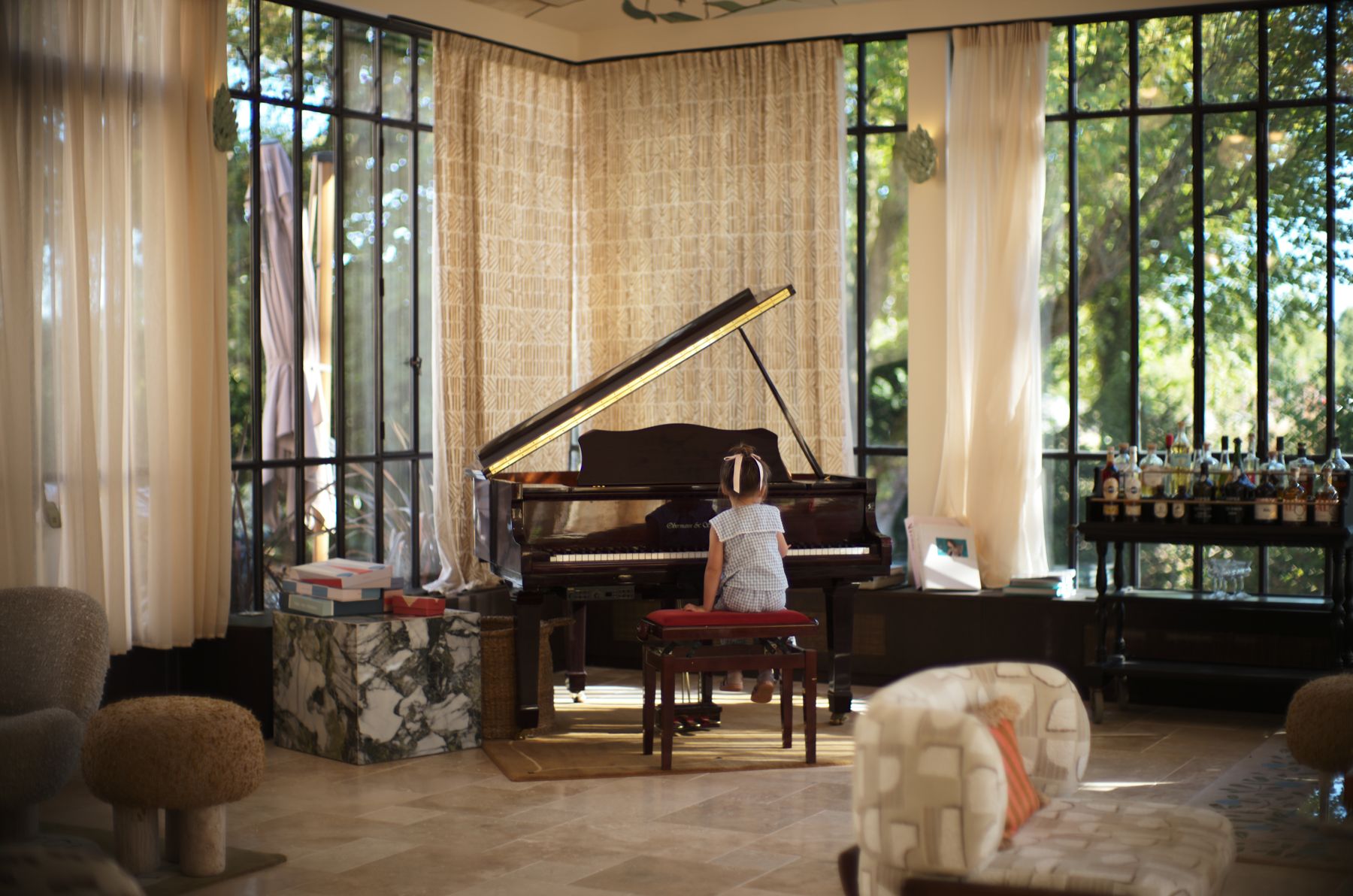
Camille Agnès Omerin came from fashion, years at Chloé and then her own label, Maison Père, which had drifted into furniture before the hotel came along. She took it over in June 2022 and spent two and a half years on it. There is no architect of record. She drew the dining chairs and the headboards, had vases and wall lamps made to her designs, and chose the artists one by one. Choosing seven of them one at a time tells you most about her. She kept the glasshouse, iron and glass in the Eiffel manner, a tea room by day and a bar until eleven at night, with Ségolène Derudder's four seasons on the roof and a line of poetry painted into the frescoes: J'aime ton exquise âme unique. Asked what a guest should take away, she said: “Definitely the daylight coming through the glass roof. The play of light at every hour is fantastic.”
THE ARTISTS
The brief to each was a wall, or a floor, and the run of the house. Ségolène Derudder, an illustrator and fresco painter working between Biarritz and Paris, took the largest share: the four seasons as Greek gods and goddesses across the glasshouse ceiling, the two dining rooms, and lines of poetry painted straight onto the bedroom walls. A blue-haired cherub plays the violin on the dining-room ceiling. Margot Gillot mixes her own paints from lime and casein, the way fresco painters did before tins existed, and made a different picture in every bathroom. Ben Arpéa painted the floor of the outdoor pool, a landscape he calls A Spring in Normandy; Alice Louradour did the indoor pool in bright geometry. Celeste, a duo from Mexico City, filled the curved stairwell over two floors with a desert landscape, Hacia el vacío. Hermentaire, the painting name of Damien de Medeiros, took the spa, and Kimmy Quillin, a New York painter, the orangery. Gillot's bathrooms are the ones I would go back for, with Celeste's stairwell close behind.
“I hate conformism, looking like everyone else,” Omerin said last winter. “It was obvious to me that I had to stand out, that everything should be singular, from the washbasin to the teaspoon.”
THE ROOMS
Seventeen rooms, split between the main house and an annexe, and no two are the same. Palette rooms run from twenty to twenty-nine square metres, with king beds. Rêverie suites are bigger, thirty-five to fifty square metres, with a sitting room and, in some, bunk beds for children. Eden suites range from thirty to thirty-seven square metres, each with a conservatory, and one is fully accessible. Two family suites of fifty square metres take four: Écrin in the main house with bunk beds, Lyrique in the annexe with two doubles. A pair of connecting rooms in the annexe can be joined. There is no television in any of them, on purpose, and a projector if you ask. That is the decision I like best here. I stayed in a Rêverie and would book it again, for the sitting room and a door to shut on the children; take an Eden instead if you want the sunroom. Derudder's verses turn up on bedroom walls across the house; do ask for one.
THE TABLE
Patiné, the restaurant, has two rooms of the old house, with its mouldings and angel bas-reliefs and fireplaces in pink and red marble. Cyril Coutin cooks. He came through the Trianon Palace at Versailles and Marc Meneau's L'Espérance at Vézelay, and he and his wife Lucie already run Le Madeleine, their own restaurant a few streets away in the town. I like that he was not imported for the occasion. Shopping the Verneuil market on the church square on Saturday mornings, he builds the day's dish from what he finds. “Normandy is so rich in its diverse and varied agriculture, from the sea to the land,” he says.
Do book for the gastronomic menu, which runs Thursday and Friday nights, Saturday lunch and dinner and Sunday night. Separately, Sunday lunch is a brunch from midday with a pianist, and it is the sitting I would choose. The rest of the time there is Esquisse Gourmande, a short menu of oysters, salmon, salads and cheese with the house focaccia, served all day, every day, without booking.
THE SPA AND THE GARDEN
Under the garden's old cedars and two-hundred-year-old plane trees sits the outdoor pool, open in summer, with Arpéa's spring on its floor. Indoors there is a pool with glass doors onto a terrace, a hammam, a wooden sauna and a treatment room run with the French brand Holidermie. Hermentaire painted the whole wing with his invented tribe, and the painting carrying on past the bedrooms is the point of the place. The hotel calls it the Spa des Songes, the spa of dreams, and it is late: the indoor pool was promised for spring 2026, and the hotel now says the end of October. I would not travel for the spa alone yet. If the spa matters to your dates, ask before you book.
THE TOWN
Founded in 1120 by Henry I, son of William the Conqueror, to hold the line of the Avre against France, Verneuil-sur-Avre held until Philippe Auguste took Normandy in 1204. He put up the Tour Grise, a keep of local brown stone called grison, to keep an eye on his new town. I like that the town's most striking building was put there to watch it. The Madeleine church grew a Flamboyant Gothic tower, fifty-six metres and 212 steps, finished around 1525 and visible from the fields for miles. North of town is the plain where the English won what they called a second Agincourt in August 1424. The springs of the Avre valley at Verneuil have been piped to Paris as drinking water since 1893. That tells me more about the valley than the battle does. Beyond the town is the Perche, hills, bocage and manor houses, with its own cider appellation since 2020 and the boudin fair at Mortagne in March.
The Verdict
Go now for the house, the walls and the table, and after October for the spa. This is a real house with a real history, an owner who made every decision herself, and seven artists who were given the walls. Drive out on Friday, book a Rêverie suite, eat at Patiné on the Saturday, stay for the Sunday brunch under the glass roof, and drive back when it is over.
GETTING THERE & WHEN TO GO
By car it is about an hour and a half from Paris on the A12 and then the N12 towards Dreux and Alençon, with parking and four electric chargers at the house. Given the choice, I would take the car. If you would rather not drive, direct TER trains run from Paris-Montparnasse to Verneuil-sur-Avre in about an hour and ten minutes, and from the station the hotel is a quarter of an hour on foot, or five minutes by taxi. Sunday trains back are thin, with the first afternoon departure after four. The hotel closed from mid-January to early February this year, so do check before booking a winter date. Late spring and September are the months I would aim for, with the outdoor pool open and the glasshouse at its best in the long light.
More Luxury Hotel ReviewsHôtel Costes, Paris · The Danai, Halkidiki · The World's Most Cinematic Hotels
PhotographyAll photography by Splendid Magazine, captured on the Leica M Series.
FROM THE SPLENDID SHOP
Frequently Asked Questions
Where is Verneuil la douce?
In Verneuil-sur-Avre, now part of Verneuil d'Avre et d'Iton, in the Eure on the edge of the Perche in Normandy. It is about an hour and a half from Paris by car on the A12 and N12, or an hour and ten minutes by direct TER from Paris-Montparnasse, with the station a quarter of an hour's walk away.
How many rooms does Verneuil la douce have?
Seventeen rooms and suites across the main house and an annexe: Palette rooms of twenty to twenty-nine square metres, Reverie suites of thirty-five to fifty, Eden suites of thirty to thirty-seven with a conservatory, and two fifty-square-metre family suites. None of them has a television, by choice.
Who decorated Verneuil la douce?
The owner, Camille Agnes Omerin, who came from fashion and drew much of the furniture herself, and seven artists she commissioned: Segolene Derudder, Margot Gillot, Ben Arpea, Alice Louradour, Hermentaire, Kimmy Quillin and the Mexico City duo Celeste.
Is the spa open?
The hotel says the Spa des Songes and the indoor winter pool open at the end of October 2026, having first been promised for the spring. The outdoor pool, with Ben Arpea's painting on its floor, is open in summer. Ask the hotel before booking if the spa matters to your dates.
What is the restaurant at Verneuil la douce?
Patine, where Cyril Coutin cooks. The gastronomic menu runs Thursday and Friday nights, Saturday lunch and dinner and Sunday night, by reservation; Sunday lunch is a brunch from midday with a pianist; and a short all-day menu called Esquisse Gourmande is served without booking.
When is Verneuil la douce closed?
It closed from mid-January to early February in 2026. Late spring and September are the months to aim for, with the outdoor pool open and the glasshouse at its best in the long light.